
Radical removal of malignant lesions may be improved using tumor targeted dual-modality probes that contain both a radiotracer and a fluorescent label, to allow for enhanced intra-operative delineation of tumor resection margins. Since pretargeting strategies yield high signal-to-background ratios, we evaluated the feasibility of a pretargeting strategy for intra-operative imaging in prostate cancer using an anti-TROP-2 x anti-HSG bispecific antibody (TF12), in conjunction with the dual-labeled diHSG peptide (RDC018) equipped with both a DOTA chelate for radiolabeling and a fluorophore (IRdye800CW) for near-infrared fluorescence (NIRF) imaging.
Nude mice implanted s.c. with TROP-2-expressing PC3 human prostate tumor cells or with PC3 metastases in the scapular and suprarenal region were injected i.v. with 1 mg of TF12 and, after 16h of tumor accumulation and blood clearance, were subsequently injected with 10 MBq, 0.2 nmol/mouse of either 111In-RDC018 or 111In-IMP288 as a control. Two hours p.i., both microSPECT/CT and fluorescence images were acquired, both before and after resection of the tumor nodules. Subsequently, the biodistribution of 111In-RDC018 and 111In-IMP288 was determined. The biodistribution of the dual-label RDC018 showed specific accumulation in the TROP-2 expressing PC3 tumors (12.4±3.7% ID/g at 2h p.i.), comparable to 111In-IMP288 (9.1±2.8% ID/g at 2h p.i.). MicroSPECT/CT and NIRF imaging confirmed this TROP-2-specific uptake of 111In-RDC018 in both the s.c. and metastatic growing tumor model. In addition, PC3 metastases could be visualized preoperatively with SPECT/CT and could subsequently be resected by image-guided surgery using intra-operative NIRF imaging, showing the preclinical feasibility of the pretargeted dual-modality imaging approach in prostate cancer.
Times Article Highlights Research on Universal Screening for BRCA Mutations
The New York Times recently reported on new research findings that suggest all women over 30 be screened for BRCA mutations, regardless of family history. The research was conducted on an Ashkenazi Jewish group in Israel and asserts that some women who tested positive for cancer-causing genetic mutations during random screenings may have higher rates of breast and ovarian cancer even when they have no family history of the disease.

Gene mutations in either BRCA1 or BRCA2 place individuals at higher than average risk for developing certain cancers, most notably breast and ovarian cancer. Inherited mutations in the genes BRCA1 and BRCA2 are rare — only about 1 in 500 to 1 in 800 individuals have a mutation. However, individuals of Ashkenzi Jewish ancestry have a 1 in 40 chance of carrying a BRCA gene mutation.
Even with recent research, there is still general disagreement about cancer risk in families who have BRCA mutations but no known family history of cancer. Although some now think that all women should be screened, others advise against routine genetic counseling and testing for women whose family history doesn’t indicate a risk of harmful mutations. Due to this uncertainty, some women may find themselves facing difficult choices, such as opting for surgery when they may not need to.
Susan Domchek, MD, executive director of the Basser Research Center for BRCA at the University of Pennsylvania’s Abramson Cancer Center, commented in the article on the psychological and social impact on patients who test positive for BRCA mutations: “These are not trivial,” she said. “They have the potential to cause harm.”
It’s worth noting that this research was done in an Ashkenazi Jewish group in Israel and not in a general US population group. We know that Ashkenazi Jews have a much higher chance of carrying a BRCA mutation than those of other ethnic groups.
When to Consider Genetic Counseling
In a family with a significant history of breast and/or ovarian cancer, the first step is to seek genetic counseling with an expert. Genetic counseling will help determine the best approach to testing in your family.
Consider genetic risk evaluation for BRCA testing if:
You or a family member has had:
- Breast cancer at age 50 or younger
- Ovarian or fallopian tube cancer at any age
- Cancer in both breasts
- Male breast cancer
- Breast cancer and are of Ashkenazi Jewish ancestry
You have two or more family members with any of the following cancers:
- Breast cancer
- Ovarian or fallopian tube cancer
- Pancreatic cancer
- Prostate cancer (at least one diagnosed under age 60)
Educational Events and Resources for Cancer Risk Evaluation and Genetic Screening
Join the Basser Research Center for BRCA, the Program for Jewish Genetic Health and the JCC in Manhattan for Testing for Cancer Risk in the Jewish Population: A Community Conversation on Monday, November 3 at 7:30 p.m. at the JCC in Manhattan.
Amy Harmon, a Pulitzer Prize winning New York Times journalist, will moderate a panel of medical experts in a lively discussion about testing for BRCA mutations in the Jewish community. She also will engage the audience in a conversation about the controversial topic of population testing all Ashkenazi Jews for these mutations. Read more information and RSVP online.
As always, you can find information on cancer risk evaluation, BRCA mutations, and the genetic counseling and testing process online at Basser.org
Focus on Cancer RSS Feed 2014-09-23 10:00:00
The New York Times recently reported on new research findings The research was conducted on an Ashkenazi Jewish group in Israel and asserts that some women who tested positive for cancer-causing genetic mutations during random screenings may have higher rates of breast and ovarian cancer even when they have no family history of the disease.

Gene mutations in either BRCA1 or BRCA2 place individuals at higher than average risk for developing certain cancers, most notably breast and ovarian cancer. Inherited mutations in the genes BRCA1 and BRCA2 are rare — only about 1 in 500 to 1 in 800 individuals have a mutation. However, individuals of Ashkenzi Jewish ancestry have a 1 in 40 chance of carrying a BRCA gene mutation.
Even with recent research, there is still general disagreement about cancer risk in families who have BRCA mutations but no known family history of cancer. Although some now think that all women should be screened, others advise against routine genetic counseling and testing for women whose family history doesn’t indicate a risk of harmful mutations. Due to this uncertainty, some women may find themselves facing difficult choices, such as opting for surgery when they may not need to.
Susan Domchek, MD, executive director of the Basser Research Center for BRCA at the University of Pennsylvania’s Abramson Cancer Center, commented in the article on the psychological and social impact on patients who test positive for BRCA mutations: “These are not trivial,” she said. “They have the potential to cause harm.”
It’s worth noting that this research was done in an Ashkenazi Jewish group in Israel and not in a general US population group. We know that Ashkenazi Jews have a much higher chance of carrying a BRCA mutation than those of other ethnic groups.
When to Consider Genetic Counseling
In a family with a significant history of breast and/or ovarian cancer, the first step is to seek genetic counseling with an expert. Genetic counseling will help determine the best approach to testing in your family.
Consider genetic risk evaluation for BRCA testing if:
You or a family member has had:
- Breast cancer at age 50 or younger
- Ovarian or fallopian tube cancer at any age
- Cancer in both breasts
- Male breast cancer
- Breast cancer and are of Ashkenazi Jewish ancestry
You have two or more family members with any of the following cancers:
- Breast cancer
- Ovarian or fallopian tube cancer
- Pancreatic cancer
- Prostate cancer (at least one diagnosed under age 60)
Educational Events and Resources for Cancer Risk Evaluation and Genetic Screening
Join the Basser Research Center for BRCA, the Program for Jewish Genetic Health and the JCC in Manhattan for Testing for Cancer Risk in the Jewish Population: A Community Conversation on Monday, November 3 at 7:30 p.m. at the JCC in Manhattan.
Amy Harmon, a Pulitzer Prize winning New York Times journalist, will moderate a panel of medical experts in a lively discussion about testing for BRCA mutations in the Jewish community. She also will engage the audience in a conversation about the controversial topic of population testing all Ashkenazi Jews for these mutations. Read more information and RSVP online.
As always, you can find information on cancer risk evaluation, BRCA mutations, and the genetic counseling and testing process online at Basser.org
October 17: Lung Cancer Prevention and Patient Education Conferences with Free to Breathe
Penn’s Abramson Cancer Center and Free to Breathe Philadelphia are teaming up to provide a free day-long lung cancer education conference highlighting prevention, diagnosis, treatment, genetics and life after lung cancer treatment.
Attendees will receive up-to-date information on the latest laboratory research, treatment advances, clinical trials, and survivorship issues.
There are two different sessions for the day, including Focus On Lung Cancer Conference and CANPrevent Lung Cancer Conference. Each session can help those at risk, newly diagnosed or who have survived lung cancer for a long time, find support, answers and possible alternatives to current treatment.
7th Focus On Lung Cancer Conference
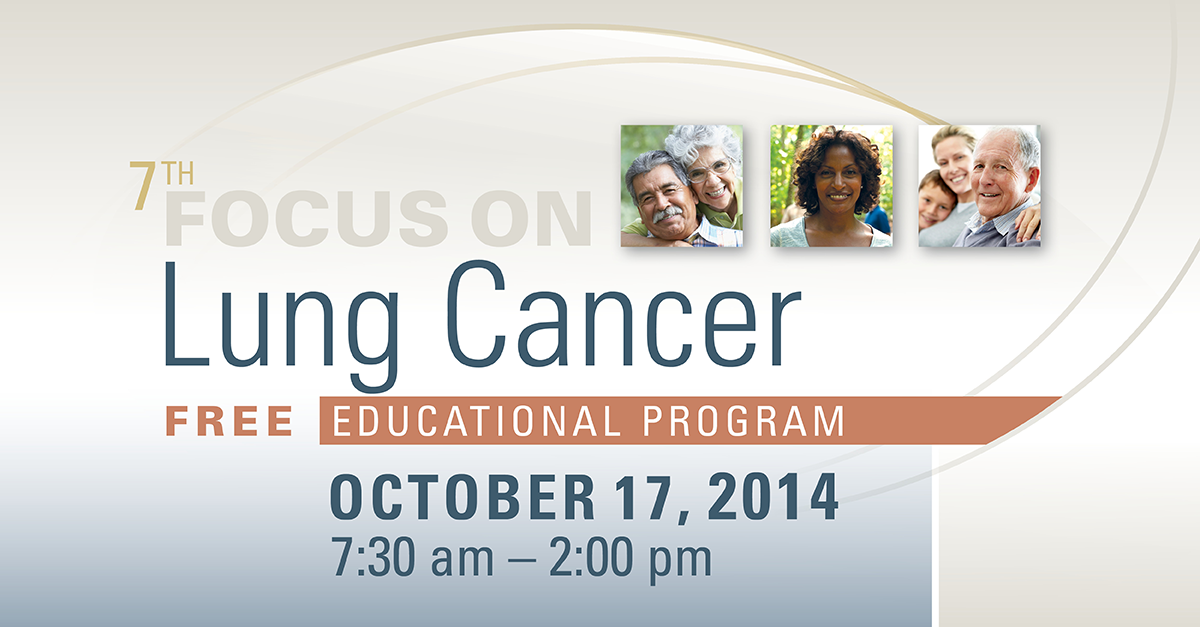 Date: Friday, October 17, 2014
Time: 7:30 am to 2:00 pm
Location: Hilton Hotel, 4200 City Avenue, Philadelphia, PA
Looking for information from medical professionals? Learn from expert panels about lung cancer prevention, risk, and quitting smoking.
RSVP for the Focus on Lung Cancer Conference here.
3rd CANPrevent Lung Cancer Conference
 Date: Friday, October 17, 2014
Time: 12:30 pm to 2:00 pm
Location: Hilton Hotel, 4200 City Avenue, Philadelphia PA
Are you or a loved one newly touched by lung cancer? Join us for risk assessment, new diagnostics and procedures, surgical advances, information on proton therapy and more.
RSVP the for CANPrevent Lung Cancer Conference here.
Can’t Make the Conference?
If you can’t make this year’s conference, you can watch or follow the conference live:
- View the Focus On conference live stream online (not active until the day of the events)
- Join @PennCancer on Twitter with the hashtag #LungCancerACC to follow the day’s topics and discussions.
- Join the 9th Annual Free to Breath Run/Walk November 2, 2014
The Cure is Within the Abramson Cancer Center
Learn about the Lung Cancer screening and treatment options available today.
Learn about the Lung Cancer screening and treatment options available today.
TRAP1 Controls BRAF Synthesis and Cell-Cycle Progression
Human BRAF-driven tumors are aggressive malignancies with poor clinical outcome and lack of sensitivity to therapies. TRAP1 is a HSP90 molecular chaperone deregulated in human tumors and responsible for specific features of cancer cells, i.e., protection from apoptosis, drug resistance, metabolic regulation, and protein quality control/ubiquitination. The hypothesis that TRAP1 plays a regulatory function on the BRAF pathway, arising from the observation that BRAF levels are decreased upon TRAP1 interference, was tested in human breast and colorectal carcinoma in vitro and in vivo. This study shows that TRAP1 is involved in the regulation of BRAF synthesis/ubiquitination, without affecting its stability. Indeed, BRAF synthesis is facilitated in a TRAP1-rich background, whereas increased ubiquitination occurs upon disruption of the TRAP1 network that correlates with decreased protein levels. Remarkably, BRAF downstream pathway is modulated by TRAP1 regulatory activity: indeed, TRAP1 silencing induces (i) ERK phosphorylation attenuation, (ii) cell-cycle inhibition with cell accumulation in G0–G1 and G2–M transitions, and (iii) extensive reprogramming of gene expression. Interestingly, a genome-wide profiling of TRAP1-knockdown cells identified cell growth and cell-cycle regulation as the most significant biofunctions controlled by the TRAP1 network. It is worth noting that TRAP1 regulation on BRAF is conserved in human colorectal carcinomas, with the two proteins being frequently coexpressed. Finally, the dual HSP90/TRAP1 inhibitor HSP990 showed activity against the TRAP1 network and high cytostatic potential in BRAF-mutated colorectal carcinoma cells. Therefore, this novel TRAP1 function represents an attractive therapeutic window to target dependency of BRAF-driven tumors on TRAP1 translational/quality control machinery. Cancer Res; 74(22); 1–12. ©2014 AACR.


